
Texas isn’t exactly known for its accommodating weather. In our first full summer in San Antonio, 2021, back when we were still renting, the HVAC decided to stop working. Instead of pushing out crisp cool air, it pushed out an inferno of heat that made being outside, in 95-plus-degree heat and 75%-plus humidity, feel like heaven. I let the property manager know that we would be staying in a hotel since their A/C tech couldn’t get out and look at it until Friday. It was Monday. He shot back a text message letting me know they wouldn’t be covering it. I replied, “Don’t worry, I didn’t expect you to.” I decided right then I would never be that property manager. Now that I own a long-term rental property, I try to run it the way I wished mine had been run.
Before I owned a rental, I had seen my fair share of good and bad property managers. The best ones were compassionate and flexible, but firm. I have tried to mimic the best of what I had previously experienced with our first intentional investment property, the duplex. It has been far from perfect, and I have most certainly taken my licks, but I want to share with you the good, the bad, and the ugly.
What a Long-Term Rental Property Actually Is, and What It Is Not
The biggest advantage of a long-term rental (LTR) over a short-term rental (STR) or mid-term rental (MTR) is predictability. Tenants sign leases of a year or longer. That is a year of “guaranteed” income. Predictable, yes. Passive, no. The IRS may call rental income passive, but my weekends disagree. A broken garbage disposal is still broken whether the income is classified as passive or not.
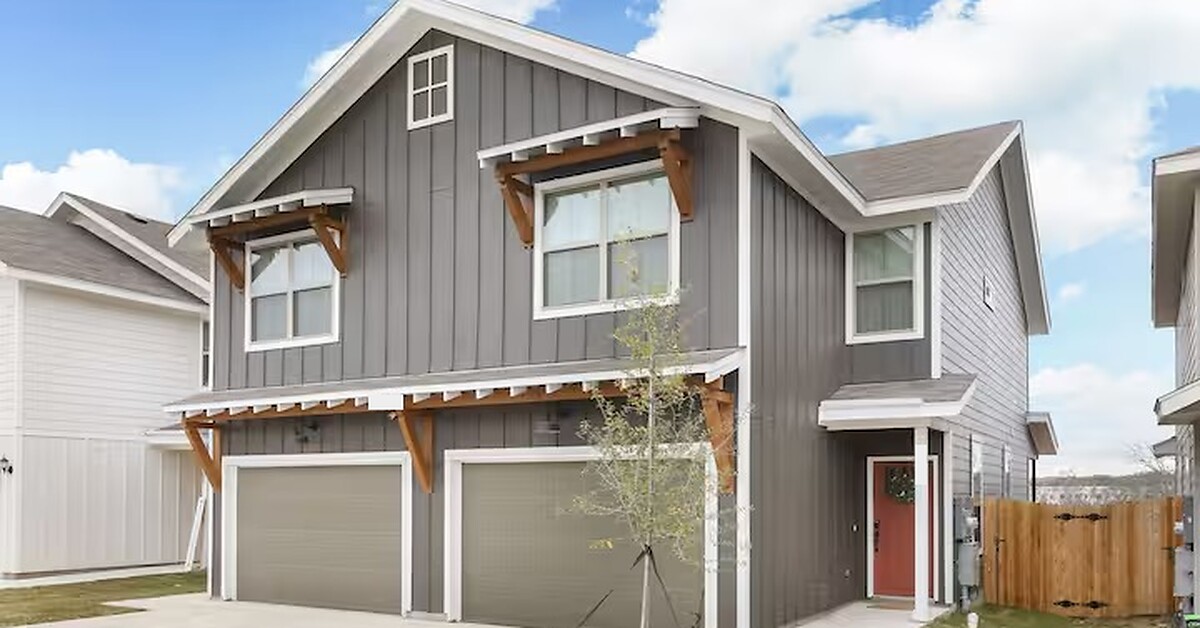
We bought our San Antonio duplex in 2021 with an FHA loan as a house hack. We lived on one side and leased that side as a long-term rental in August 2023. The other unit followed a completely different path. It ran as a short-term rental from early 2022 to early 2025, when we started moving it to mid-term. We target traveling professionals through Airbnb and Furnished Finder.
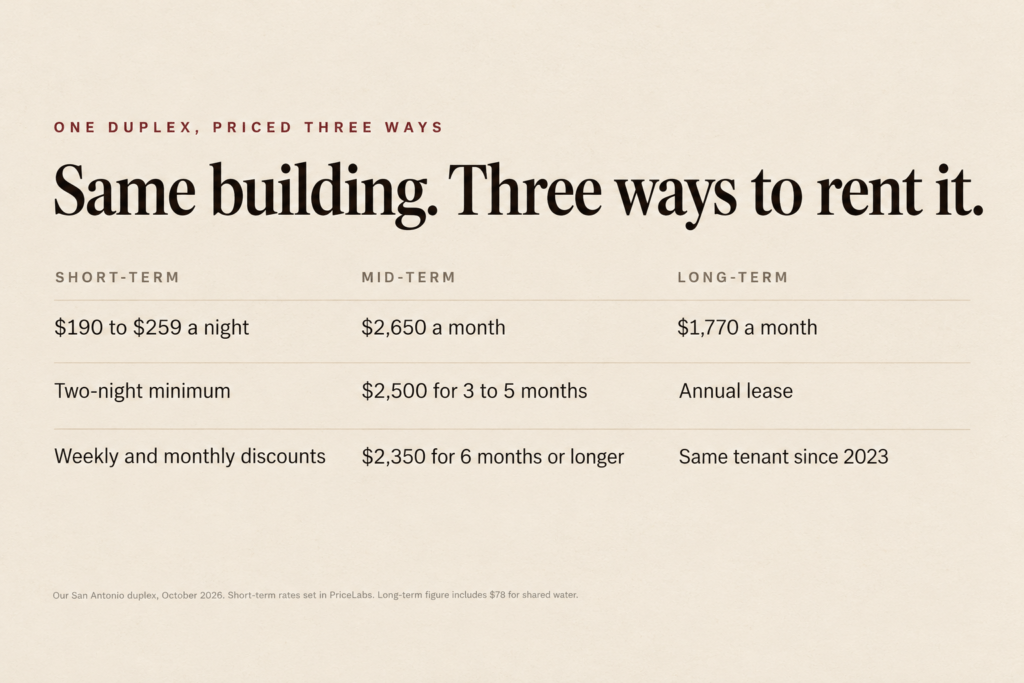
The long-term side currently brings in $1,770 per month, every month, until the lease is renewed. That consists of $1,692 in rent plus $78 for water, which is a shared utility between the two units. Our tenant takes care of all other utilities (garbage, internet, electricity, etc.). More importantly, we have had the same tenant since 2023. No turnover, no vacancy, because there hasn’t been a second tenant.
Why I Chose a Long-Term Rental Property for One Side
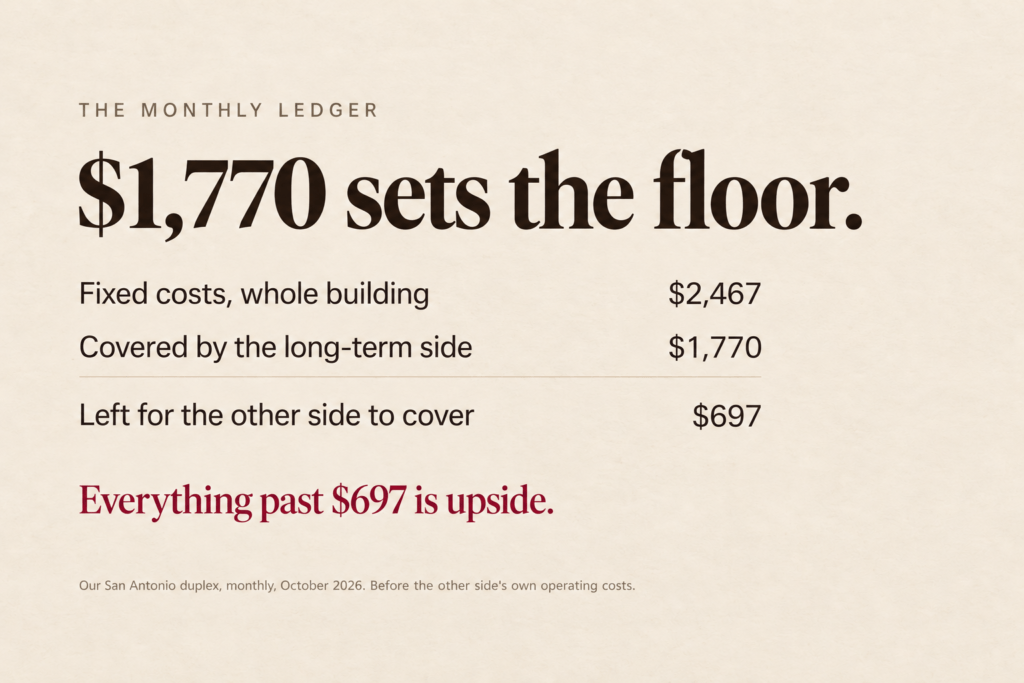
My decision to make one side of the duplex an LTR and the other an STR/MTR is simple: I wanted one side for consistency and the other to capture the upside. The mortgage, taxes, and insurance cover both units, because the lender, the tax office, and the insurer all see one property. The long-term side’s $1,770 covers all but about $697 of the property’s fixed costs. Included in my $2,467 fixed expenses are the mortgage, insurance, taxes, and HOA fees. That means the STR/MTR only needs to generate $697 to cover the fixed expenses before its own operating costs like cleaning, utilities, and supplies. It’s the same cash flow over appreciation thinking I wrote about earlier.
One Side Is the Floor. The Other Is the Upside.
Short- and mid-term rentals have predictable slow months, short-term most of all. January and February are historically slow months for that side of the duplex. That side feels the slow months. The long-term side doesn’t. A spreadsheet doesn’t care what you forecasted once you enter the actuals. The tenant owes rent on the first of every month under our annual lease. That’s as guaranteed as income gets. That contract sets a $1,770 floor every month.
How the Short-Term Side Supports a Long-Term Rental Property
The short-term side captures upside because I can change the price nightly, with demand and with the season. We just had an MTR guest check out on 10/7. We have no other MTR stays lined up, but we do have a weekend warrior staying at the duplex. The goal is to maximize occupancy without sacrificing profit. We use PriceLabs to manage our STR pricing. We set a $190 minimum, a $225 base, and a $259 maximum per night. If guests stay longer, we offer discounts on a weekly and monthly basis. We have a two-night minimum stay that receives no discount.
Mid-Term Rental Pricing Next to the Long-Term Side
The MTR is a happy medium between the STR and LTR regarding pricing and operational stress. Like the long-term side, its pricing is mostly fixed. Right now, as a corporate rental, we charge $2,650 a month. For stays of three to five months, we adjust the price down to $2,500 a month. If they stay six months or longer, we set the price to $2,350. As with the short-term side, we want to encourage people to stay longer, which creates stability and predictability. Even at the lowest mid-term rate, $2,350, the mid-term side clears the $697 gap by $1,653 a month before its own operating costs.
Getting the Unit Ready Before the First Tenant
Call me Captain Obvious, but a rent-ready property should be prepared for somebody to live in it, not just for a 15-minute showing. I didn’t want to be the property manager from that summer. I genuinely want to provide a place where a tenant is proud to call their home.
When we bought the duplex in 2021, it didn’t need renovation. That was one of the selling points to me. It made the conversation with my wife Thais about turning one side into an LTR that much easier. There was no deferred maintenance, no HVAC rattling out its last few pushes of cold air, and the plumbing was, for all intents and purposes, brand new. No YouTube-certified DIYer had been in the walls. Just an Andy.
Best Flooring for a Long-Term Rental Property
In fact, the changes we did make were nothing more than aesthetics: flooring. Vinyl plank is the better floor for most rentals, and it happens to be in style right now. Landlords get durability, maintenance, and ease of cleaning. Tenants get a floor that doesn’t trap dust and allergens, and it’s quieter and warmer underfoot than tile.
Rent-Ready Checklist: Texas Rekey Law and Turnover Basics
Under Texas Property Code § 92.156, landlords must rekey door locks and other keyed security devices within seven days after each tenant turnover, at the landlord’s expense. As we moved out, not only did we rekey the home, but we swapped all batteries in smoke alarms, changed the air filters, touched up paint, and did a deep clean. Those are the basics that should be done every single turnover, at a minimum.
What the Numbers Have to Clear
In Cash Flow vs Appreciation, I had discussed how I like to use the 1% rule. However, the 1% rule is getting harder to use as a benchmark. In our current environment, the average 30-year mortgage rate hit 7.28% on October 1, 2026, according to Freddie Mac, up from 6.34% a year earlier. I hate to say this, but I need to rethink the 1% rule and its utility in how I make quick decisions on properties that I would like to purchase.
Mortgage Rates on an Investment Property: What 7.28% Does to the Payment
The 1% rule can still work as a filter, but not an answer. Monthly rent should be at least 1% of the price. At 7.28%, each $100,000 borrowed costs about $684 a month in principal and interest. At 2.5% it was about $395. The rule never changed, but the payment it ignores went up by more than half. The interest rate on our home, purchased in June 2023, is 4.99%, and our duplex, purchased in September 2021, is 2.50%. Interest rates can fluctuate very rapidly and make a good deal bad. While the interest rate should never decide a deal, it means all the other factors need to be more dialed in, especially in terms of market rate rents.
The real test is whether the projected income covers the property. Can you cover the debt service of the property and still have room to cover other fixed and variable expenses? For me to cover my fixed expenses, that number is $697. This means having an understanding of the market, current rents, and if you don’t live there, boots on the ground to gather information that Zillow or Rentometer won’t. A good local realtor can be one of your greatest assets.
How I Screen Tenants
The two times I needed a tenant for the duplex and condo, a realtor found and screened them. I use RentRedi, which has a screening tool built in. I’ve been lucky enough not to need it yet. When I do, this is the process.
Now there are some obvious criteria that every landlord/property manager should be screening for. Depending upon where you’re located, there could be other lawful criteria, but here are the big four: identity verification, income, credit information, rental history. Together they answer four questions: Is this person who they say they are? Do they earn enough to pay rent every month? Do they pay their bills on time? How did they treat their last place? This ensures, to the highest degree possible, you can collect rent every month and that they will adequately take care of your property.
Whatever your criteria, the Fair Housing Act bars screening on race, color, national origin, religion, sex, familial status, or disability, according to HUD. Write your criteria down before the first application and apply them the same way to everyone.
The Lease Is the Product
In Texas, the lease determines a lot of what happens after the handshake and the tenant gets the keys. It matters most when eviction comes up. Leases depend heavily on state and local rules, and they deserve their own post. The takeaway: you don’t want to discover what your lease says for the first time when something goes wrong.
Texas Security Deposit Law for a Long-Term Rental Property
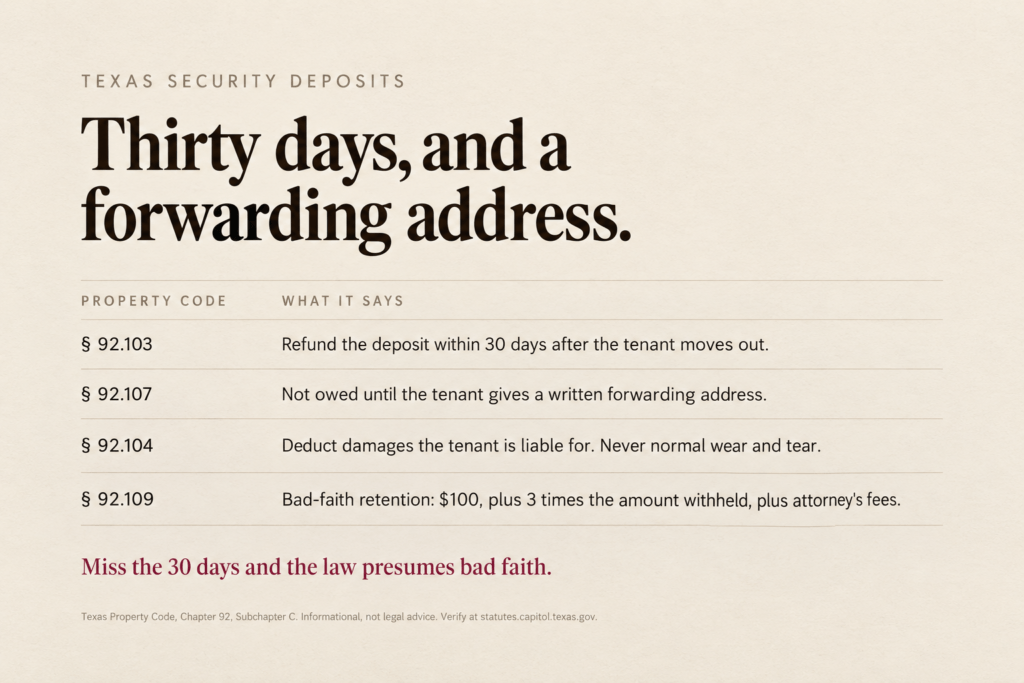
Each state has different rules, so I will be referencing the state in which I live, Texas. Under Texas Property Code § 92.103, a landlord must refund a security deposit on or before the 30th day after the tenant surrenders the property. Under § 92.107, a landlord is not obligated to provide a refund or itemization until the tenant provides a written forwarding address. Under § 92.104, the landlord can deduct damages and charges the tenant is legally liable for under the lease, but never normal wear and tear. Hold a deposit in bad faith and § 92.109 makes you liable for $100, plus three times the amount withheld, plus the tenant’s attorney’s fees. Miss the 30-day deadline and the law presumes bad faith.
Texas Late Fee Law: What You Can Charge
What can the landlord legally do when the tenant misses payments or gets into the possibility of eviction? Under § 92.019, a late fee must be in a written lease, must be reasonable, and can’t be charged until rent is two full days late. For a building with four or fewer units, a fee up to 12% of monthly rent is presumed reasonable. My late fee kicks in five days after rent is due to avoid confusion and provide good faith. One late payment isn’t a reason to evict. A pattern is. Documentation of the tenant’s bad faith and your good faith becomes critical at this point as does all correspondence (email, text, calls, etc.).
Texas Eviction Process After the 2026 Changes
Eviction starts with written notice, three days unless the lease says otherwise. Texas changed the rules on January 1, 2026: if the tenant has never been late before, the notice must be “pay rent or vacate,” which gives them a chance to catch up, and a notice can no longer be taped to the outside of the door. Once you file, the justice court sets trial 10 to 21 days out. My lease allows one day. I’d still give three, because one day shows bad faith and, in my opinion, is just bad business not taking care of people.
Texas REALTORS Residential Lease for a Long-Term Rental Property
The lease is a document that should not be rushed. I strongly recommend having an attorney or a realtor/property manager draft the lease for you. An attorney might be expensive the first time, but you can keep it and use it as a template for other properties. A realtor/property manager will be cheaper, but they’ll most likely use the Texas REALTORS Residential Lease, the standard form from the state realtors’ association. Texas doesn’t require any particular lease form. I opted to go with a realtor, and I do a lease extension every year. Basically, the original lease stays the same, but the dates, rent, utilities, whatever changes, go into the extension, and the lease stays in force. I send a copy of the original (signed) and the lease extension (signed) to my tenant upon renewal.
What a Long-Term Rental Property Actually Costs to Run
Something that you must always remember is that the tenant will never care about the property as much as you do. It doesn’t matter if it is STR, MTR (which honestly, if it’s a corporation, they have an incentive to keep it nice), or LTR. The tenant will beat it to hell and then be shocked when something is broken. A maintenance routine keeps the mechanical systems working from one tenant to the next.
Rental Property Inspection and HVAC Maintenance Routine
For me, with my long-term rental, I inspect the property every 6 months. I do a full walkthrough once a year, where I’m checking the fridge, the microwave, the oven, the stove, and the dishwasher. If I provide the appliance, I test it. Then I check the HVAC system about every 3 to 6 months.
What I do is change the filter, and I’ll also pour apple cider vinegar down the condensate drain line (the drip line). That’s to ensure that the HVAC system operates properly, especially here in the Texas heat. Sometimes that drip line can get backed up, and then it starts dripping out of the secondary, which, for our duplex, is actually near the front door.
Condensate Drain Line Clogged: What My Tenant Reported
Not too long ago, the tenant reached out and let me know that the secondary drip line had water coming out of it, and it had actually been coming out for a while. Since it’s been hot, the HVAC system has been working overtime, so all I had to do was pour some apple cider vinegar down the drip line. Now the HVAC system can work properly.
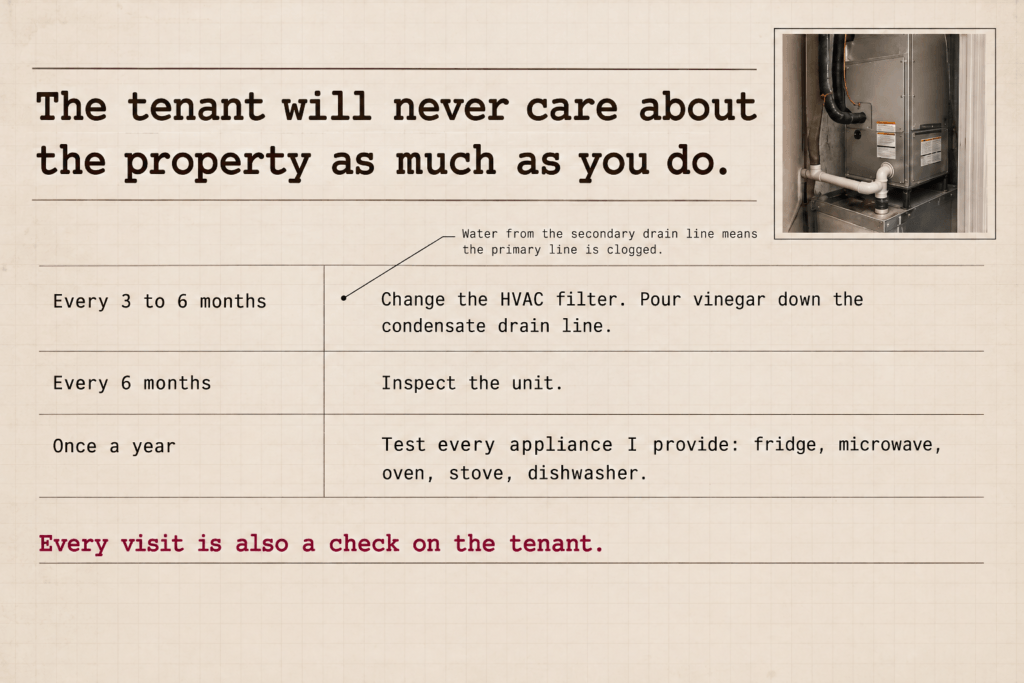
Routine maintenance is critical because you can’t trust that the tenant is going to do it, so I like to do it myself. Now, granted, it’s a little bit easier for me because I’m only really managing one property right now, but once again, go back to rule one: the tenant will never care about the property as much as you do.
Long-Term Rental Property Expenses: What I Spent Last Year
Changing the filters also gives me a reason to check in on the tenant and the property. Last year, I spent a total of $199.82. I spent $60.65 on filters. They come in two packs from Amazon and cover the year. I bought one 128 fl oz bottle of apple cider vinegar for $36.99. I did have to replace the garbage disposal, which took me about an hour and cost $102.18. That was it for the long-term rental side. In terms of my time, including bookkeeping, I spend approximately 8 hours a year on it.
What I Got Wrong
My first landlord experience happened by accident in 2020 with our condo in San Diego. I bought it as a place for Thais and me to live and hadn’t put too much thought into turning it into a rental. That was until COVID happened. I became an incidental landlord and eventually sold the condo at a loss of about $18,000. This experience has helped shape how I think about the duplex.
Landlord Mistakes: Letting Rent Slide on a Long-Term Rental Property
I’ve operated a home improvement business. I’ve dealt with tenants of my own. I’ve run short-term, mid-term, and long-term rentals. I know substantially more now than I did in 2020, but that doesn’t mean I know everything. I was the landlord at first that let rent constantly slide. I let the tenant on five separate occasions pay half rent at the beginning of the month and then the rest “when they could.” That turned into no payment. It all changed when I served notice. The tenant paid all late fees and caught up on rent. They have not missed a payment for the past 2 years nor have they asked for an extension. It was avoidable by me holding the standard set in the lease.
I would argue now that I know enough to fully understand the risks, but not enough to fully mitigate all of them. There will always be risks in any business that you own and real estate is no different. If I could talk to the version of myself prior to 2020, I would tell him to plan for the worst case and hope for the best. I always knew the downtown property could become a rental, but it never once factored into my decision-making process. When we bought the house we live in now, you bet your ass I factored in it being a rental property. I should have spent more time understanding whether the property in San Diego could succeed as a rental. Based on the mortgage and monthly HOA fees, it didn’t.
Come Build With Me
Brick & Yield is where I’m building the plane while I fly it. This isn’t a version where every decision I made was perfect, or where I retired as a multi-millionaire at 26 and will share my secrets with you for a nominal fee of $599 to join my mastermind. I’ll keep breaking down the duplex, the numbers behind it, the contractor’s perspective, the decisions I would make differently, and deals that I am looking to move on.
If you’re building your own portfolio, come build with me. Leave a comment or email me at [email protected].
Disclosure & Disclaimer
This post may contain affiliate links. I may earn a small commission at no extra cost to you. See our full Affiliate Disclosure.
I’m sharing my own experience as a real estate investor, not professional financial or investment advice — always do your own research before making decisions with your money.