

I was recently talking with my dad about painting one side of the exterior of his home and he was asking me about how to choose a contractor. He had two contractors come out and they each presented wildly different prices and time frames for the work to be completed. The first contractor quoted approximately $2,500 and 3-4 days of work. The second contractor quoted approximately $6,500 for 1-2 weeks of work, which could get longer and add to the cost. If you have ever hired someone to work in your house, you have probably made a bad hire at least once.
I wrote about the decision that comes one step earlier in DIY or Hire It Out? How I Decide: Skill, Time, and True Cost. Skill is the veto, time and true cost are the trade-offs. This post picks up one step later, after you have decided you are not doing the work yourself. Now you must pick who does.
While choosing which contractor to go with is a difficult question, it is equally difficult for contractors to decide which homeowners to trust. If the contractor is looking to rip you off, obviously they don’t care about their reputation and are only concerned with getting your money into their pocket. Good contractors will not take every job and there are most certainly good customers and bad.
What I Looked For When I Was the One Getting Hired
I hate the saying, “Customers are always right.” First and foremost, that is not accurate, but this is true: “Customers are always right in matters of taste.” A good contractor will work with a customer to achieve their goal. After all, the customer didn’t have the skill, time, or both to complete it, which is why they’re hiring a contractor to do it.
I knew if a project would be successful or not from my initial interactions with a customer. We did jobs that I knew would be nightmares, but I wanted to try and make them work. One was building a chicken coop. I wanted to make sure we had work and the gentleman wanted to save some money. I get it, but you must be realistic in terms of expectations and what you’re paying for. There were multiple flags along the way that I noticed, but I ignored.
The Three Red Flags I Ignored
The three red flags were that he had no drawings and would not pay us to produce them, the job was labor only, and he wanted to hold payment until completion. No drawings were the BIGGEST of the red flags and most concerning. I had to convince him to send me a rough sketch and pictures of what he was looking for.
Labor only, while it isn’t good, isn’t a deal killer always. The problem with labor only is the person buying the material doesn’t know everything that it takes to complete the project. Painting a house doesn’t just require paint. Not only that, but the project is also waiting for them to source something they may or may not know anything about.
Finally, he wanted me to cover the cost of his project by not paying until it was done. I still had to cover my business expenses while completing work for them.
Those were my flags looking at him, and the rest of this is yours looking at me. So, as an investor, what should you be looking for when hiring a contractor?
How to Choose a Contractor: Verifying License and Insurance
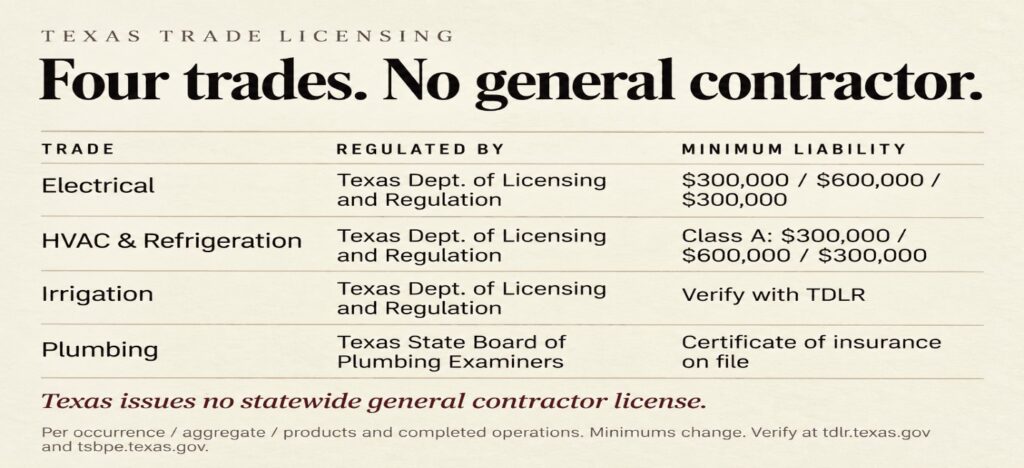
The purpose of licensing and insurance is to protect you as a consumer and the person completing the work. Each state is different and you should consult your state’s department of licensing or commerce and county clerk. I live in the state of Texas, more specifically San Antonio, and will use that as the basis for this section. The Texas Department of Licensing and Regulation licenses electrical, HVAC and refrigeration, and irrigation. Plumbing runs through the Texas State Board of Plumbing Examiners.
I called Development Services and asked. What they told me is that if you are doing work in this city, you register. What the city publishes is narrower. Registration is what gets you a permit, and there is a whole list of work that needs no permit at all. My dad is in Maine, so none of this applies to him. That is the point. Licensing, registration, and permits change at every state line and most city lines, and the answer for your property is not the answer for his. If you want the real answer for your project, call them. You can also verify a contractor license yourself through the state agency that issues it, which takes about two minutes.
License vs. Registration: Know the Difference
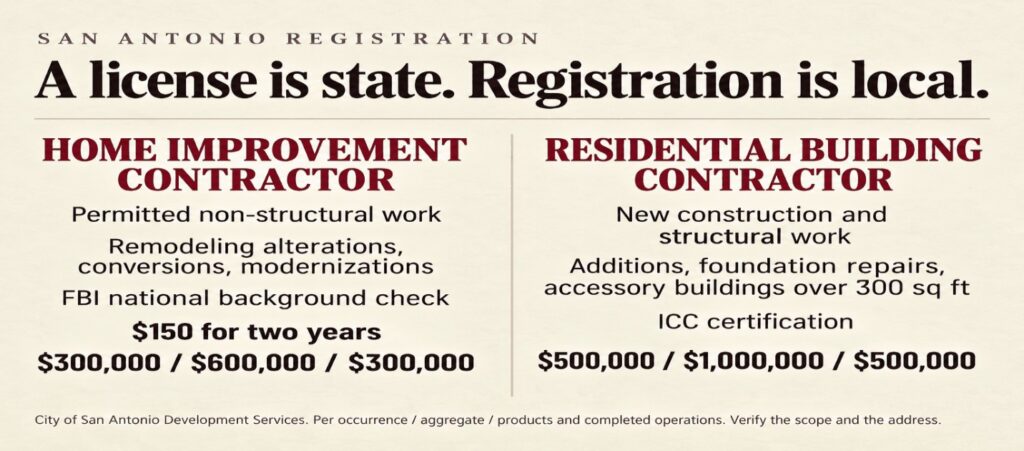
The City of San Antonio tiers registration. Home Improvement Contractor covers permitted non-structural work: remodeling alterations, conversions, modernizations. It requires an FBI national background check and costs $150 for two years. Residential Building Contractor covers new residential construction, structural alterations or remodeling, additions, foundation repairs, and detached accessory buildings over 300 square feet. It adds an ICC certification. A license is held at the state level. Registration is local.
Specialty trades carry their own state and local requirements. Texas still issues no statewide general contractor license, but local registration, permits, and insurance can all apply. According to the Texas Department of Insurance, Texas doesn’t require most private employers to carry workers’ compensation. Here is how Texas handles each of the licensed specialty trades.
Now, here are the City of San Antonio requirements for Residential Building Contractors and Home Improvement Contractors:
How to Choose a Contractor: What to Verify First
This is a very complex topic that can (and probably will) be its own post in the future. I will leave you with this. As an investor, you must protect yourself. At a minimum, you should get a Certificate of Insurance (General Liability and Workers’ Compensation if they have it), verify a contractor license through the state or city that issues it, and do a quick search to see if they have a Google Business profile, a website, reviews, and anything else that can help you build a picture of whether this is a legit business or someone that is perfectly fine with taking your deposit and blocking your number.
Read the Estimate Before You Read the Total
This doesn’t just mean price. If the price is all you care about, none of the previous verification is required. Contractors need to ensure their business is healthy and that means being profitable. This is no different than you as an investor. Would you purchase a property if you weren’t going to make money? Price is important, but it shouldn’t be your bottom line…pun intended.
How to Choose a Contractor by Reading the Scope
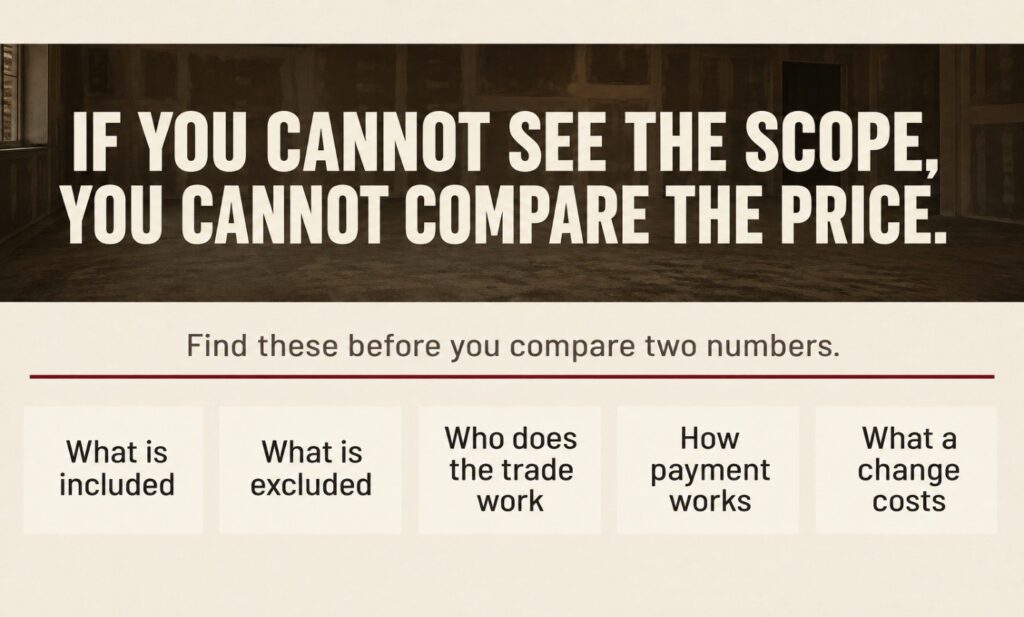
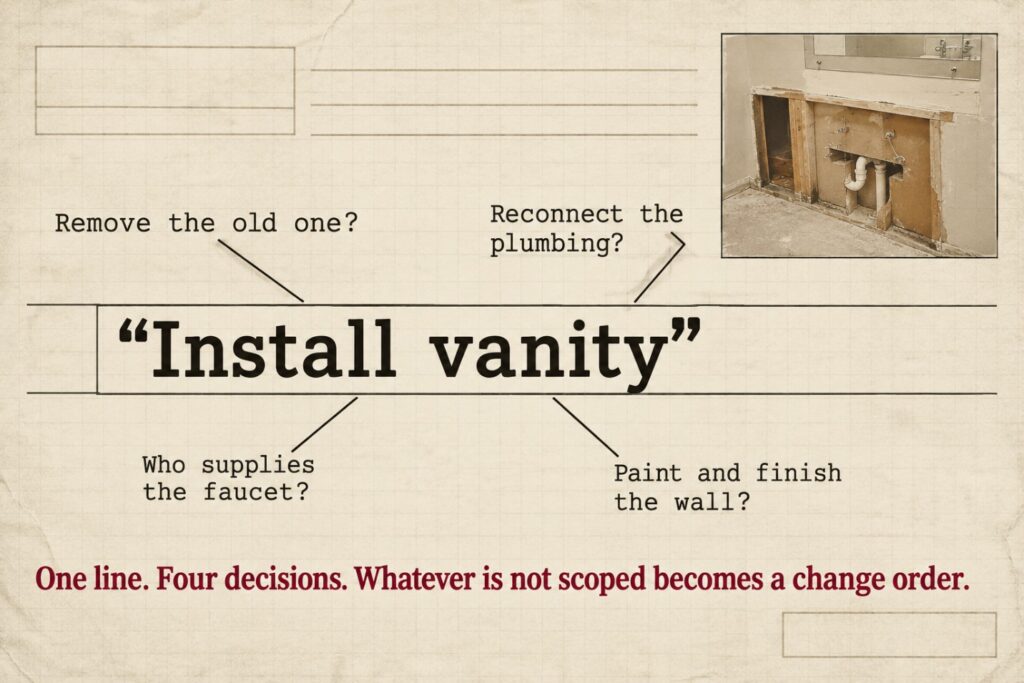
Each estimate should include a scope, a combined line-item costing to perform the whole scope, and terms of execution. The scope should paint a picture of your vision. If you’re renovating a bathroom, it should provide words that invoke the final visual you’re looking for. Not just “sink.” Dual vanity sinks with two cabinets, finished in dark blue, black handles, chrome faucet. Each scope will have various sub-tasks to bring your vision to life. Installing a cabinet vanity requires multiple tasks.
First, the old vanity (if there is one) needs to be demoed. Then, the contractor needs to install the new vanity. Plumbing also needs to be connected. Is there existing plumbing or are you installing new plumbing? A licensed plumber needs to install the new plumbing. Who will be doing that work? What is their license number? Finally, the finishing touches. Paint, accessories, faucet. What color is each one, and who is picking? This will more than likely be one line item on the estimate, and this is why the scope has to say what is in it. Each contractor will be different, so make sure it is clear.
A final piece to look for on the estimate is how payment works. What is the required deposit? What methods of payment are acceptable? Do they have financing? These things may vary from project to project, so it is good to be clear on this upfront before work is agreed upon.
An estimate should invoke confidence that the contractor understands what you’re looking for, a budget, and that they have envisioned the final product in your home. You should understand how they conduct work and give you an outline of exactly what will be done in your home. If it isn’t scoped into the project, it will be a change order and those come at a high cost, which could make or break your investment.
Contractor Red Flags That Matter
The estimate is very important. I can’t stress that enough; however, it isn’t always the end all be all. Remember the chicken coop I referenced earlier. The three issues I identified, plus my failure to step in until it was too late, cost me just over $15,000 in work I was never paid for. We had an extremely detailed scope of work in that estimate, and it did exactly what a scope is supposed to do. When we hit week 5 of a 2-week project, I could walk him line by line through every piece of additional work his “good idea fairy” had added. What the scope could not do was make him pay for it. A scope like that protects both sides, but only if someone enforces it, and I did not. What are some red flags you as an investor should look out for from your contractor?
Never Pay for the Whole Project Up Front
Sometimes the best thing you can do is go with your gut and if any of these red flags show up, I am sure your gut will tell you. First and foremost, you should never pay for the whole project up front. A deposit is a reasonable request, and it makes sure everyone has some skin in the game. Each contractor will do things a bit differently, but generally, I required an initial deposit between 20% and 50% of the total cost of work. The bigger the project, the smaller the percentage required as an initial deposit. However, if it is a big project, you should be paying upon completion of milestones that the contractor has clearly laid out.
When Cash Is the Only Option
The second biggest flag is requiring cash. In today’s day and age, if this is a legitimate business, they should give you options to compensate them for their work. If the only option is cash, I wouldn’t necessarily rule them out, but I would be mindful of everything else they provide so I can truly gauge how they operate. I had someone do work at my house once and after they completed the work, that is when they let me know that they only accepted cash. Not a person I would ever recommend or hire again in my house.
How to Choose a Contractor You Would Hire Again
Now, obviously not every project is the same in size and scope, but there is one constant: transparency and communication. There are a lot of good contractors. Unfortunately, the bad ones get all the attention.
The contractor should be able to articulate a result that captures what you want accomplished. They might provide renderings, images of similar work, but convey to you that they understand what you want done and have documented it on the estimate and articulated it through understanding as you answered their questions. They explain how they operate: communication, milestones, what they can and can’t do and how they overcome it, warranty. Good contractors want to be an open book, within reason. They treat you with respect and understand that this is an investment that you intend to make money on, just like what they intend to do with their work.
Come Build With Me
Here is what I am curious about. Everyone reading this has a contractor story and most of them are bad. Mine involves a chicken coop and five weeks I am not getting back.
Tell me yours. What was the flag you saw and ignored? I want to know whether the thing that got you is the thing I would have caught, because I am not convinced it is. I ignored my own on that coop, and I was the contractor.
Leave your story in the comments. If you’re still deciding whether to take on the work yourself, start with DIY or Hire It Out?
Disclosure & Disclaimer
This post may contain affiliate links. I may earn a small commission at no extra cost to you. See our full Affiliate Disclosure.
I’m sharing my own experience as a real estate investor, not professional financial or investment advice — always do your own research before making decisions with your money.