

My Duplex Investment: From Accidental to Intentional
Building our own home meant countless hours in the design center, and that’s what led us to our first duplex investment. What followed was a fast-paced, full-contact sport that demanded novices like us execute with professional precision:
Sales Rep: “What are you thinking for tile?”
Me: “Well, we weren’t…”
Sales Rep: “You can have this style, or this one, or this one. We can give you whatever you want.”
Me: “What is the stand…”
Sales Rep: “If you don’t know that’s ok. We can move onto the next section and always come back.”
This interaction led my wife and I to our intentional duplex investment. As we rapidly drank from a fire hose and struggled to follow the sales rep at the design center, she quickly went through our options. To her, this is what she did all day every day. We had never built a custom home before. My wife was visibly distraught. When pressed to slow down, our request fell upon deaf ears as their objective was to get us in and out as quickly as possible, regardless of whether we knew what we were purchasing.
From Accidental Landlord to Intentional Investor
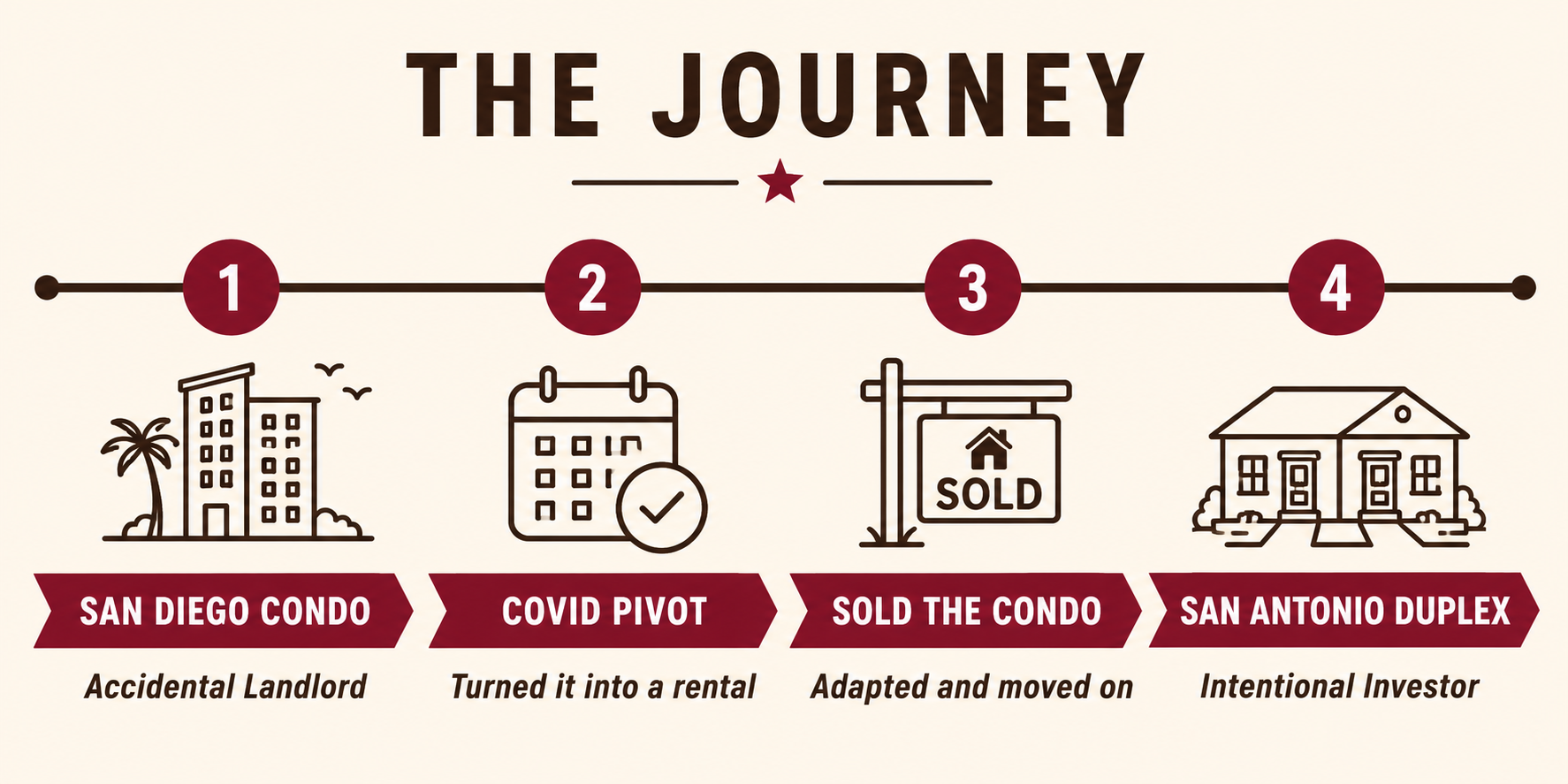
If you read my first blog, “Here’s How I Started: Building Wealth, One Brick at a Time”, you know that we started our journey as accidental landlords. We were stuck in our condo in downtown San Diego while a worldwide pandemic destroyed our hopes of a clean exit. We knew we would be losing money, but how much? Our goal was to slow the “bleeding” and turn the property into a rental until the real estate market became more normalized. As with many things, real estate investing requires adaptability. So, we adapted to our environment, rented out our property, and sold when the market became more sensible.
Our duplex house hack was our first true intentional investment in real estate where we planned on collecting money from someone else to utilize our property. Our strategy was like that of many real estate investors beginning their journey: house hacking.
Finding Our Duplex Investment
As Thais’ hopes and dreams were slowly depleted with every conversation we had with the “custom” home builder, we needed to find a place to live. While I wanted to support Thais with the purchase of our home, as I saw this opportunity was quickly turning into a nightmare, I investigated laying a foundation for investing in real estate. That is when I came across a duplex by a local builder on Zillow. I know, everyone likes to talk trash about Zillow, but it isn’t all bad. I began working with my real estate agent and gathering up all the required documents to purchase the property with an FHA loan and began my due diligence. The FHA loan is a great tool for investors who are unsure on how to buy their first rental property. The FHA loan made sense for our first-time intentional investment: it required a low down payment, manageable credit requirements, and the owner-occupancy requirement aligned perfectly with our strategy.
Since I knew, we were going to house hack, live on one side and turn the other side into a short-term rental (STR), a lot of my due diligence was regarding location. Cash flow wasn’t all that important as we would be using it as our primary home, however, the potential income from a STR was considered. At the end of the day, the property didn’t need to cashflow, but the potential income could significantly help us out with our mortgage. So, if the cash-flow doesn’t support a short-term rental, it wouldn’t necessarily destroy the deal as we could turn it into a long-term rental (LTR) or even a mid-term rental (MTR). The one area that could significantly impact us, and long into the future, is the location.
The Duplex House Hack
The duplex is situated in a gated community on the far west side of San Antonio with community amenities such as a playground, dog park, and basketball court. It is a community of only duplexes. When we first bought the property in 2021, I loved the idea of it being an exclusive duplex community of investors, however, as time has gone on, I have noticed some of the risk in that. Not far from Lackland Air Force Base and SeaWorld, the property is near a constant inflow of out-of-town folks looking to attend an Air Force graduation, enjoy time with family at SeaWorld, and those traveling on business. The short-term rental would be a viable option with LTR and MTR still in play if the initial plan didn’t work.
It was simple, live on one side of the duplex and use the other as a short-term rental. Our duplex house hack investment served as an introduction to real estate investing with intention. We knew nothing about managing a short-term rental and/or how to furnish one. We didn’t truly know how things would work, but we took a risk as it made sense and was a far better investment than spending more time, energy, and money on the so-called “custom” new build which was a house with 4-5 options.
The house hack is one of the many methods new investors have used to build a portfolio of their own. The attractiveness of this strategy for us was that the short-term rental, based on my due diligence, would cover the entire mortgage on good months, with additional money for reserves, and cover half the mortgage on slow ones. There are generally requirements that must be met, like that it must be your primary residence for a certain amount of time. This is normally dictated by the type of loan you’re using to finance the investment. Every loan product will have different requirements, and it is crucial that you factor these into your due diligence.
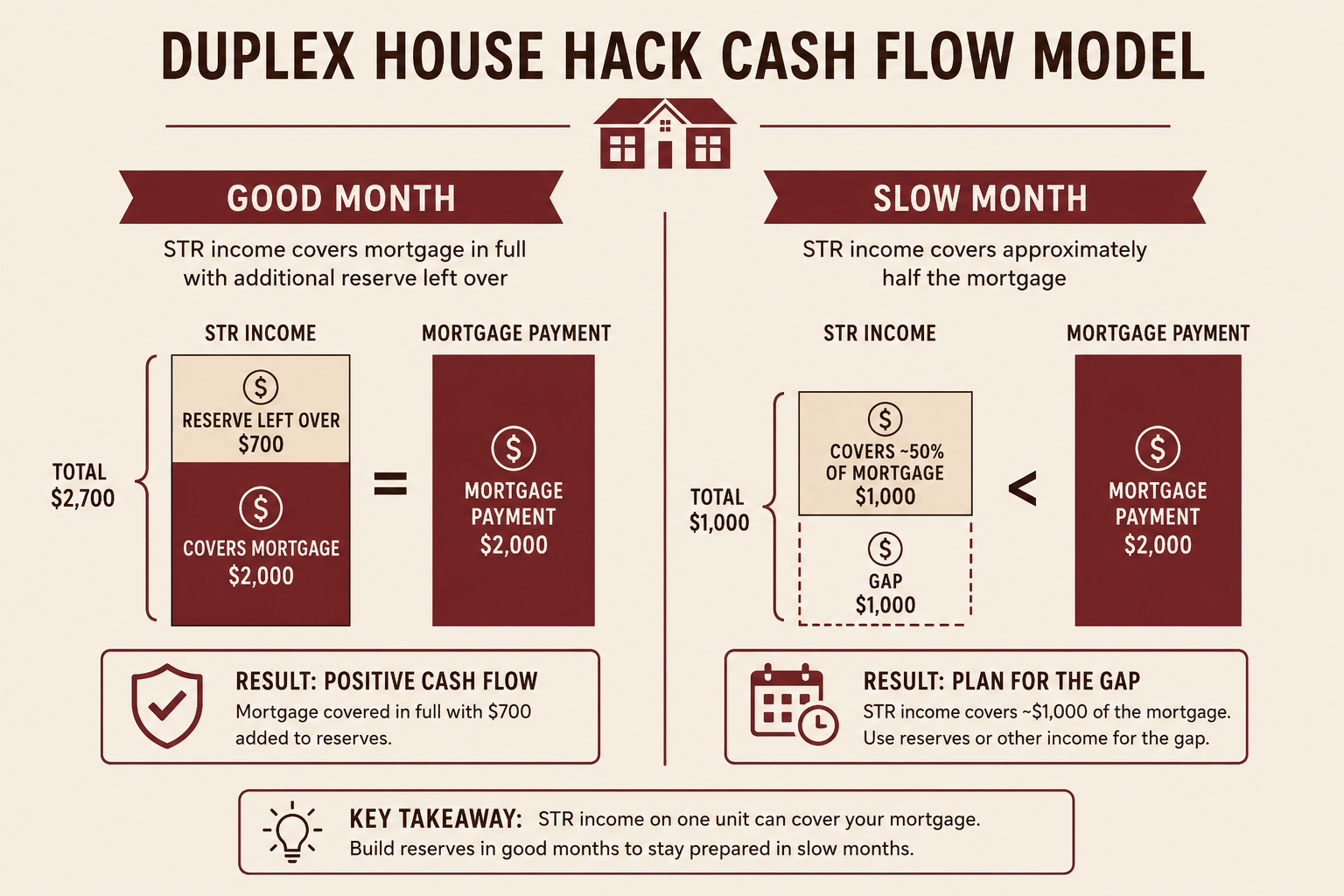
The house hack is one of the many methods new investors have used to build a portfolio of their own. The attractiveness of this strategy for us was that the short-term rental, based on my due diligence, would cover the entire mortgage on good months, with additional money for reserves, and cover half the mortgage on slow ones. There are generally requirements that must be met, like that it must be your primary residence for a certain amount of time. This is normally dictated by the type of loan you’re using to finance the investment. Every loan product will have different requirements, and it is crucial that you factor these into your due diligence.
From Short-Term to Mid-Term Rental
After we moved into our duplex investment, we began putting into action our plan to turn the other side of the property into a short-term rental. This included buying furniture, light decorations, and providing basic items that any home would have (glasses, dishes, silverware, cleaning supplies, etc.). We tried so hard to make everything “perfect”. We didn’t really need the income for the property, so we had the luxury of not needing to execute our plan super quickly. We took our time. We closed on the property in September, and our first guests (our families) didn’t stay at the property until the following March. The most important lesson we learned from this was that nothing will ever be perfect. Sometimes you just need to jump in instead of getting your feet wet. I don’t regret this strategy and since we have it under our belt, if we were to ever do another house hack, we would be much quicker to execute our plan.
While we operated the property as a short-term rental, the market was a much different time then (early 2022 until early 2025). You didn’t really need to try so hard to stand out. The location for the short-term rental was important, but you didn’t really need to have exuberant features. Properties now, to be more competitive, need to have much more robust amenities. One thing that we didn’t really do, which a lot of very good STR operators do, is a theme. We thought about doing an Air Force theme as the property is located less than 10 miles from “Gateway to the Air Force”, Lackland, but ultimately, we didn’t want to go that route. So, we have shifted our focus more toward a mid-term rental.
Cash Flow vs Appreciation: How We Think About Returns
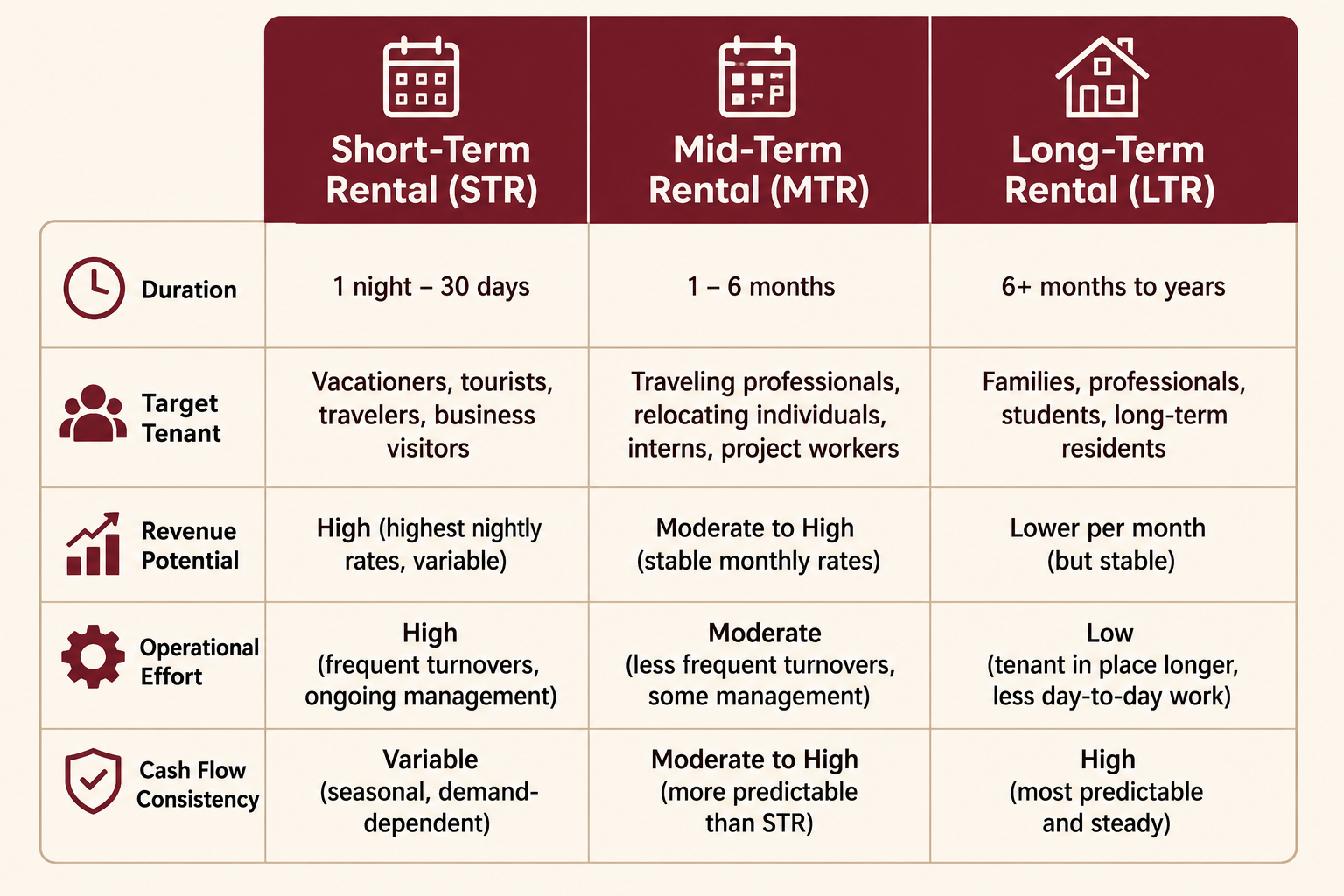
A mid-term rental is exactly what it sounds like. It is between a long-term rental, which is a minimum of 1 year, and a short-term rental which can be 1 night. Mid-term rentals are usually anything between 3 months to a year; however, mid-term rentals can sometimes turn into long-term rentals for traveling professionals. With our location in an area where a lot of people travel from out of town for work and not having all that much to differentiate from the other properties, we decided to focus our energy on attracting traveling professionals. Now, we still list our property on Airbnb and will accept short rentals, but they aren’t our target. We utilize Airbnb and Furnished Finder to drive our mid-term rental strategy.
While this decision was based upon our lackluster ability to differentiate in a duplex community of just over 100 units, there is still yet another reason: cashflow. There are any number of reasons someone invests in real estate, but appreciation and cash flow are the two main drivers. Appreciation is when the value of the property goes up over time and you’re able to sell at a higher price than what you purchased it for. Cash flow is when money comes in and then leaves to cover expenses. When I say cash flow, I mean cash flow positive. A property can be positive, neutral, or negative and will be covered in a separate blog. My current philosophy and driving decision factor: cash flow.
Where This Duplex Investment Is Taking Us
While our short-term rental has performed well, there are a lot of expenses that owners must cover to make it work. On top of having to deal with, as I call them, weekend warriors, that are constantly rotating through your property, this requires high operational attention and expenses. Paying someone to clean the property after the guest departs. Making sure that any repairs that need to be done are completed. It is a constant battle and extremely far from “passive” income as some on the internet might allude to. We can generate less revenue from a mid-term rental, but it requires less expenses, thus increasing our cash flow in a positive way. It still requires time, but the coordination and time required is less than that of a short-term rental.
What we have really been doing over the past 5 years is figuring out what we like while working full-time jobs and/or trying to grow a home improvement business. We are intentionally moving diligently through this discovery process to figure out what is best for our investing style. Real estate, whether done “part-time” or “full-time” it is a business. Trying to grow two businesses at once isn’t impossible; however, it wasn’t something I was willing to do. This blog is my journey of not only sharing that knowledge but working to formalize and press forward with our real estate wealth building strategy that we have been slowly developing. I determined that the home improvement business was not the best option for our family and decided to divest from it completely.
Come Build With Me
If you have been wondering what it is like to invest in real estate or are too afraid to take that leap, I see you. You aren’t alone. There are many people that want to diversify their investment portfolio with real estate or build a real estate business of their own. I want to help you on that journey. Join the community and let’s build your dreams one brick at a time!
Photo by Anastasia Shuraeva via Pexels
This post may contain affiliate links, meaning I may earn a small commission if you make a purchase through them, at no extra cost to you.
I’m sharing my own experience as a real estate investor, not professional financial or investment advice — always do your own research before making decisions with your money.

3 Comments