

DIY or Hire It Out? How I Decide: Skill, Time, and True Cost
I was done with ripping up the carpet, I leveled the floor with some self-leveler, and I was ready to install the vinyl plank flooring so I could complete my DIY home renovation. (If you’re here for DIY home renovation tips, buckle up, because this one didn’t go as planned.) It was sitting in our garage taking up space, which wouldn’t have been that much of a problem if it hadn’t been sitting there for weeks. I was going to install the vinyl plank flooring on our side of the duplex. I would systematically move from room to room and then finish with the hall. I had a plan. The one area I was worried about, the stairs.
It took me about a week to finish my first room. It had some weird corners, which made it more difficult. In total, it was about 8 hours of my life that I won’t get back. Not a problem, I got this. As I was working in the room that was my office, I looked at what I had created and was not happy with the result. It just didn’t feel right. Not only that, but there were also about 2 weeks between when I started my office and finished the first room. Our entire second floor of the duplex on our side had been a construction site for nearly 3 months. From when I ripped up the carpet, ALL of it, and to where I was at this point. I needed to bring someone in. If there’s one entry in my running list of DIY home renovation tips, it’s this: know when to stop.
The Wrong Question: What Most DIY Home Renovation Tips Get Backwards
Now, in my introductory blog, “Here’s How I Started: Building Wealth, One Brick at a Time”, it seemed like this whole process had gone smoothly. It didn’t. I glossed over a couple of details because they weren’t pertinent at the time. From the perspective of my wife, Thais, understanding how we could utilize income from real estate to fund and complete upgrades to add value or reinvest into more real estate, it was perfect. From the physical work being done side, it was executed by me about as smooth as sandpaper. Had I just hired someone to begin with, both perspectives would have been satisfied.
I was asking myself the wrong question, can I do this, when I should have been asking, should I be doing this. That’s the problem with a lot of DIY home renovation tips out there, they answer, “can I” and skip “should I.” A lot of professionals have heard of the project constraint triangle: time, cost, scope. You can only pick two. I prefer to think of it like this: time, true cost, skill, where skill isn’t a trade-off, but has veto power.
Time: The Real Cost of DIY Home Renovation Tips
In my situation, I had already sunk at least 15 hours into this project and still wasn’t done with the upstairs when I finally brought someone in. The person I eventually hired to do the work completed it in a week, including the stairs. While he was doing the work, I was able to focus on other things like spending time with my family (Thais and our dog Hazel). While you’re determining if you’re going to be the one doing the work, ask yourself, what is my time worth? It doesn’t necessarily have to be your salary or an hourly rate, what other things in your life are you willing to sacrifice?
Learning skills is great, but in my experience, it takes 3-4 times longer than someone who does it for a living. Additionally, if we were renovating it so we could rent it out, like we currently do, because every day the property is under construction, that vacancy costs more money. DIY projects have a tendency to stretch longer than they should. That is compounding dollars in the wrong direction. What you thought you were saving by doing it yourself is working against you. Even if I were a skillful carpenter that has experience with installing vinyl plank flooring, I could still be losing if time is the actual constraint.
True Cost: What Contractor Markup Really Buys You
On top of effectively wasting my time, which isn’t free, let’s look at the true cost. Every estimate from a contractor and our own expectations, if we plan to tackle the project on our own, hides the true cost. A quote will generally hide two things: markup and scope creep. When a contractor marks up their material, it is a sound business practice to ensure their profitability, and it is protection for you as a consumer. The markup should include a warranty, a no “do-over” risk, and speed. They’re able to guarantee the durability of the product. While a contractor should be willing to work with you, if you’re driving all the decisions on the material, they can’t ensure it’s right for the job. Scope creep occurs when the “good idea fairy” starts playing with what the original goal and objectives were that the contractor estimated. Scope creep can be costly to both homeowners and contractors. A contractor who knows what they’re doing will charge a significant price to have those changes done. A homeowner who inadvertently allows the scope of the project to get bigger, will continue to pay with more money and time.
The “free” DIY isn’t free. The most visible cost to someone having a project done is material, which is why sometimes the markup feels like a punishment, but it is really a protection for you and the contractor. What is hidden is accessibility to the tools needed to properly complete the job, trips back and forth to the hardware store, and the cost of doing it twice (or ten times) if you get it wrong. I consistently was installing the flooring improperly and had to correct my mistakes. Saying I did this 10 times is generous. I also didn’t have the proper tools. Instead of using a flooring cutter, which I didn’t want to buy as I would probably never use it again, I used a jigsaw. That was the best tool that I had readily available to tackle the cutting of the planks. Not only did it add on time, but it wasn’t the proper use of the tool, but I was “saving” money.
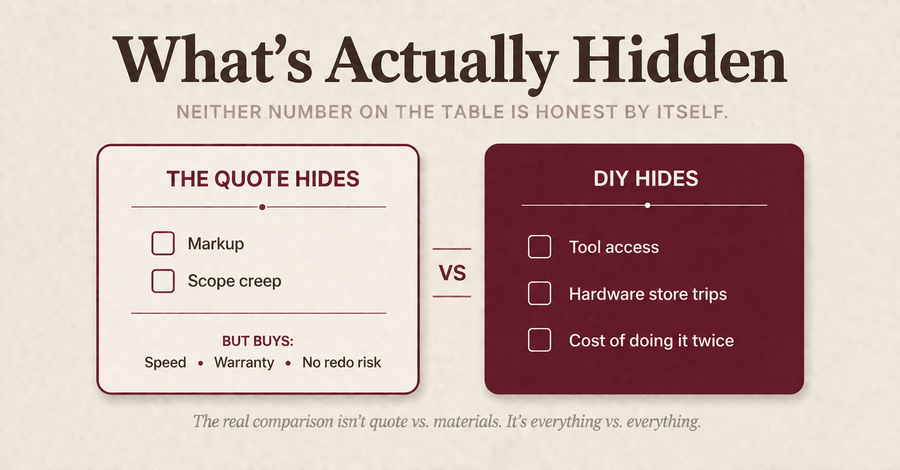
So, let’s take a realistic look at what the true cost of doing a project yourself is, because it is most certainly not just materials. When you factor in everything that a DIYer must do, it is research and purchase materials, labor to complete the work, labor to correct mistakes, and vacancy drag. Selecting a professional contractor is the quote that they present, speed, and a warranty. Now, if you’re confident in your abilities and you have nothing but time and money, I get why you might want to tackle it yourself, but you need to be very clear and honest with yourself. When I was, I realized that I was not the right person for the job. There is no harm in admitting that, in fact, that brings clarity and allows you to better use your time with your strengths. I will say that this requires the right contractor which requires due diligence and will be covered later. What they should bring to the table is skill.
Skill: What You Can Learn, and What You Shouldn't
You have the time, you understand the true cost, but do you have the skill? With my flooring project, I had time sporadically available throughout my day, I understood the true cost in that using tools that weren’t necessarily designed to complete the task were being used, but I most certainly didn’t have the skill. It is very easy to devalue the ability to just snap together some vinyl plank flooring; however, the problem is that it sounds simple, but it most certainly isn’t easy. I am all for learning new skills, but when you look at it through the lens of time and true cost, should you be doing it?
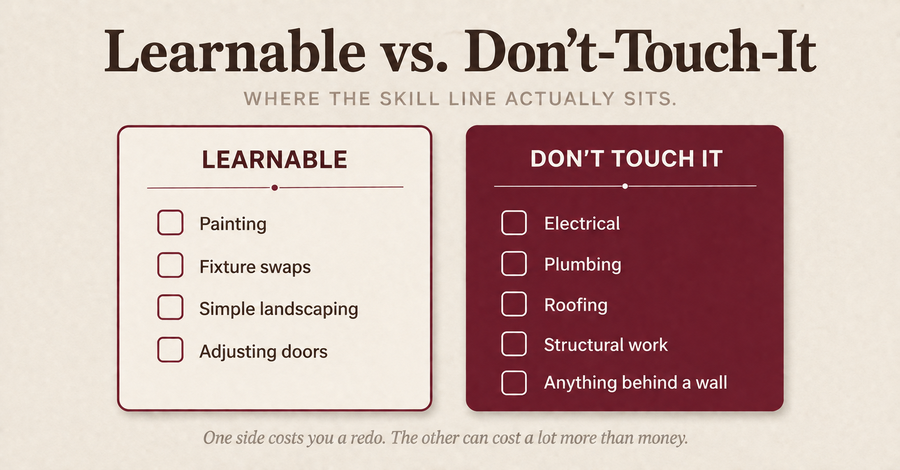
There are some basic “handyman” skills that every owner should know how to do. This includes things like painting, fixture swaps, simple landscape, adjusting doors, and other basic cosmetic tasks. Now, you can absolutely learn how to be an electrician, but should you? Just because you can learn it doesn’t mean you should and that the final product will be as good as if you hired it out. Things like electrical, plumbing, roofing, structural, and really anything behind a wall should be done by a professional. These things can not only impact the value of your investment, but also people’s lives. Home-improvement injuries send hundreds of thousands of people to the ER every year, and it’s not always the big stuff that gets you. A failure here doesn’t just mean it could be poor quality, like not putting on enough coats of paint. This failure could have life threatening implications.
When I started this flooring project, I hadn’t yet been the owner of a home improvement business. Having been through that experience I can confidently look back at this and say one thing with certainty: I should never have tried to do it on my own. It takes an immense amount of effort and money to learn the trades. It takes hours to accomplish the same repetitive tasks to become good at it, let alone proficient. Not only that, to do it properly, you must have the right tools, not just the knowledge. While there are a lot of bad contractors out there, there are a lot of extremely gifted and incredible ones. For every good one, you will probably meet five bad ones. Unfortunately, it is the bad ones that people remember the most.
How They Interact: Skill as the Veto
What is the point of this little exercise? Time and true cost are trade-offs you can weigh against each other, but skill is the differentiating factor that can veto them both.
Let’s look at two scenarios. Scenario 1, you have the skill, but don’t have the time. Scenario 2, you have the time, but not the skill. Scenario 1 is a job you are confident in your abilities; you have the tools to accomplish it quickly and effectively. The problem is you don’t have any time in your schedule to complete it. In scenario 2, you work Monday through Friday and want to knock out a quick project over the weekend. Why would you hire it out when you can do it yourself? That is a very reasonable approach to solving everyday problems; however, is the skill worth it for you to learn?
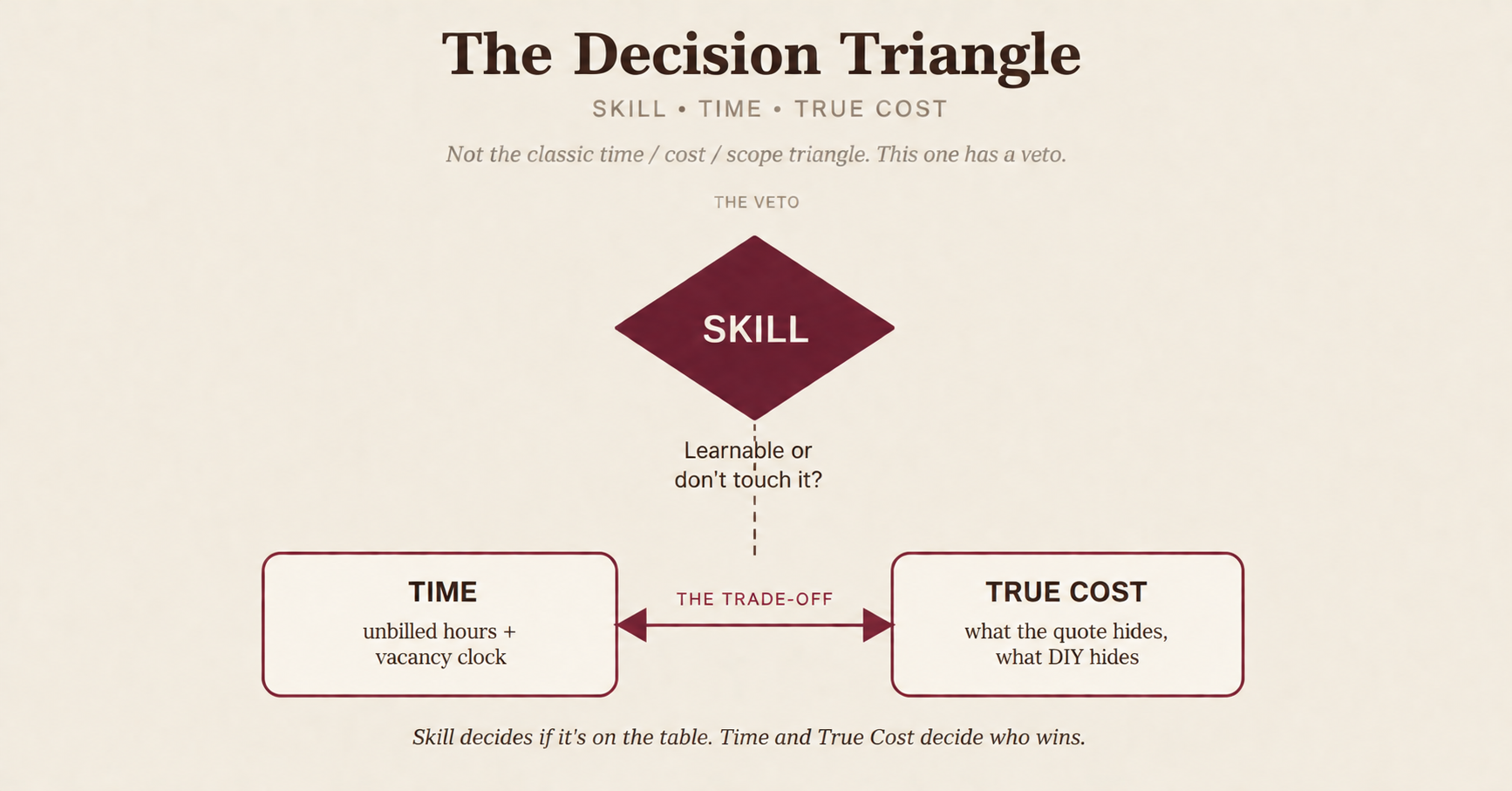
Skill is the deciding factor in all of this. If you’re going to learn a skill once and never use it again, it is more than likely not worth it. Let’s say it is, but you don’t have any of the tools to do it. Is going out and spending $1,000 on tools worth the true cost? That is why skill has the veto power in all of this. You aren’t weighing time and true cost against each other; skill is the one determining if it is all worth the effort. Should you be utilizing your skills to find the next deal or finishing off a project that can be hired out?
Real Calls Made: DIY vs Contractor
Thais and I were able to knock out a small accent wall over one weekend. I had the skill to be able to accomplish it and teach her. We both had the time over the weekend. I owned all the required tools. It was an easy, slam dunk decision that cost us about $100 in material and 6 hours of total time. We created a wall that leads into our bedroom. It consists of a light at the top with a picture of us and then our dog, Hazel, below. We framed all of that in with some trim to create a panel molding. We caulked around the trim to make the panel molding seamless with the wall and then painted over it to give it a little flair. It came out so nice that Thais asked when we could do our next project. This was nothing short of a flawless victory.
Now, let’s go back to our flooring. I got this one wrong. Did I have the skill? I would argue yes, if I had the appropriate tools (Thais would probably disagree with my assessment). However, this was never something I planned on doing again myself. I already knew the stairs were going to be difficult. I dragged out the inevitable and kept our duplex in a constant state of construction for 3 months. It was chaos! I was stressing over something that I shouldn’t have been stressing over to begin with. My energy was directed away from things that I should have been focusing on. It was an all-around failure.
Gut-Check: The DIY Home Renovation Tips I Actually Follow
There are a few simple questions that you can ask yourself to figure this out: Do I have the skill? Do I have the ability to learn it to solve this problem? Next, is it worth it for me to learn this skill? Will I be doing this again or is this a one-time deal? Does time permit for this project? Do I have the time to learn the skill and accomplish this task? Finally, do I know the true cost of this project? If I can confidently say:
- I have the skill or can learn it
- It’s worth learning
- Time permits it
- I know the true cost
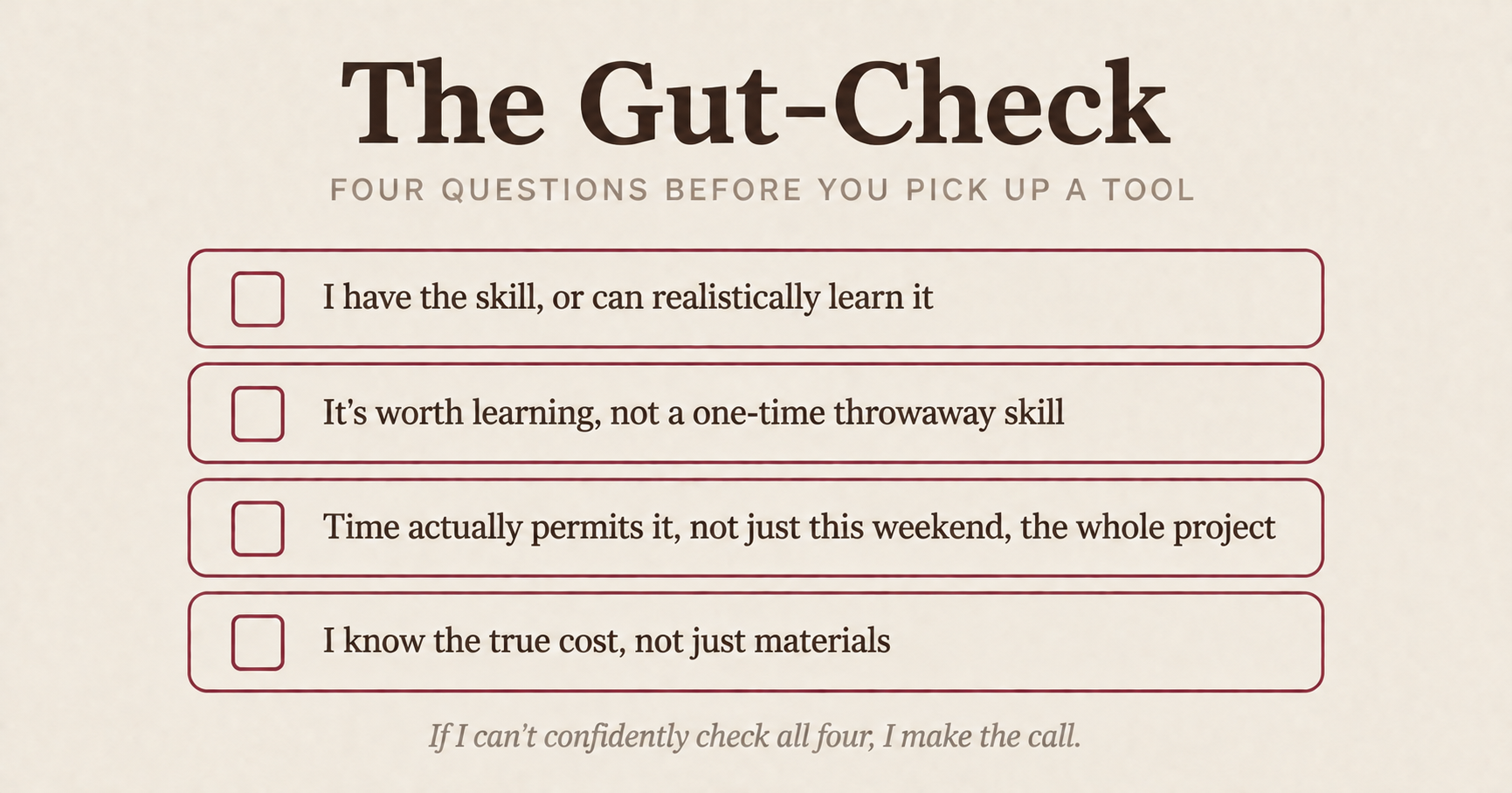
I will complete the project. If I doubt myself along the way, that is where judgement and phoning someone with experience is crucial. Number 1 and 4 are my deciding factors on almost any project. One of my flaws is that I believe I can learn anything and find value in it in the moment. I can counter that now, after MANY trial and errors, by taking a day or two before I make a decision. Knowing when to move forward can be the difference between a renovation that pays off and one that doesn’t, more on that in a future post on the highest-ROI renovations.
Come Build With Me
If you have ever bitten off more than you can chew or are in a moment in time when you’re uncertain about where to go, reach out. Sometimes the most actionable items come from the most unexpected places. If you want more real DIY home renovation tips from someone who’s made these calls, right and wrong, reach out and join the community. Follow along so we can build wealth together, one brick at a time.
This post may contain affiliate links, meaning I may earn a small commission if you make a purchase through them, at no extra cost to you.
I’m sharing my own experience as a real estate investor, not professional financial or investment advice — always do your own research before making decisions with your money.